
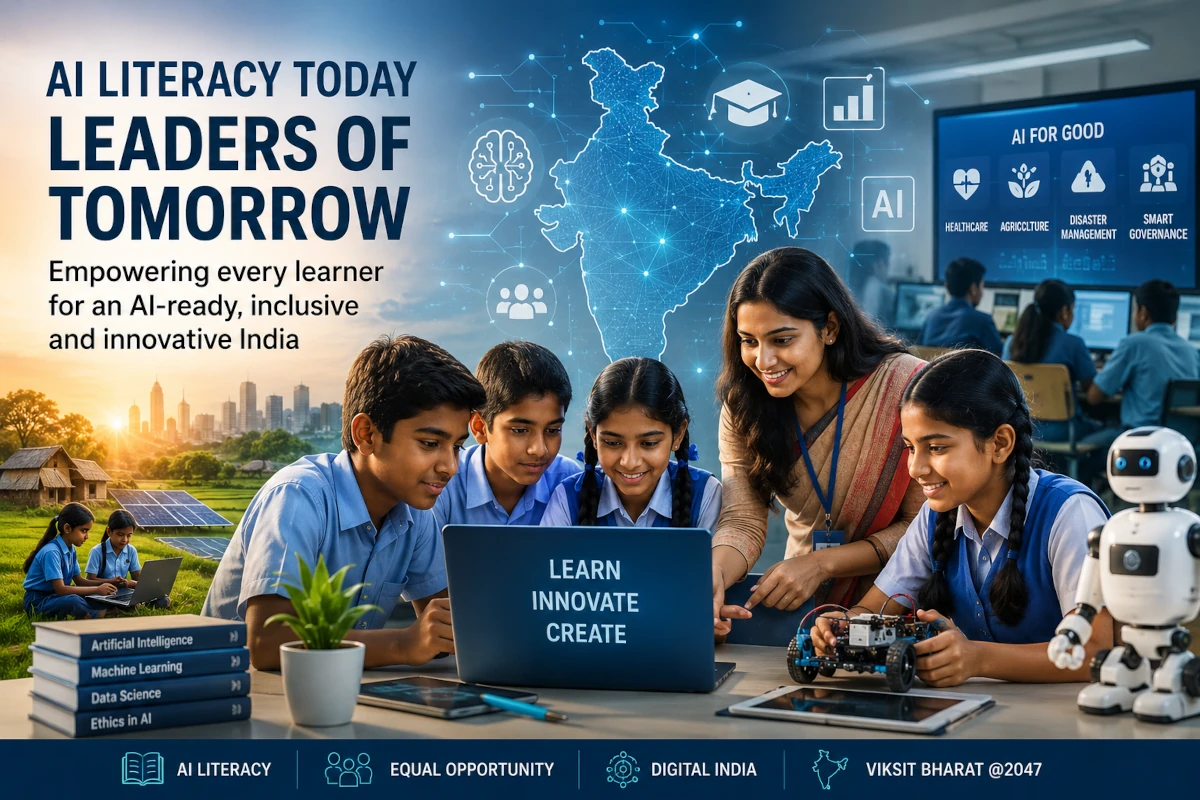
ARTIFICIAL intelligence (AI) is transforming how people learn, work, solve problems, and interact with the world. Just as literacy and digital skills became essential over the past decades, AI literacy is rapidly emerging as a core competency for the 21st century. The question is no longer whether AI will shape our future; it already does. The real challenge is whether today’s learners are prepared to thrive in an AI-driven world.
Across the globe, countries are integrating computational thinking, coding, and AI into school education. The goal is not simply to produce AI engineers but to ensure that every student understands the technologies increasingly influencing daily life. Nations such as Finland, Singapore, Japan, South Korea, the United States, and the United Kingdom recognise AI education as a strategic priority. UNESCO has likewise emphasised AI’s potential to make education more inclusive, ethical, and accessible.
India’s AI Potential
For India, home to the world’s largest youth population, AI literacy is both an educational and economic imperative. The country’s demographic dividend will remain a strength only if young people acquire skills relevant to the future economy. Otherwise, today’s digital divide may widen into a deeper AI divide.
India has already taken significant steps through initiatives such as Digital India, Skill India, PM eVIDYA, and the National Education Policy (NEP) 2020, which promotes critical thinking, multidisciplinary learning, and the integration of emerging technologies into education. The recent India-Japan Annual Summit further reinforced India’s growing leadership in AI, with both countries committing to deeper collaboration in artificial intelligence, advanced computing, semiconductors, digital innovation, and human resource development. The message is clear: future competitiveness will depend not only on advanced technologies but also on an AI-ready workforce.
Yet major challenges remain. While many urban schools have introduced coding and robotics, millions of students in government schools, particularly in rural and tribal regions, still lack meaningful access. AI literacy cannot remain a privilege for a few; it must become a public necessity.
Odisha’s Evolving AI Education Initiative
Odisha is making encouraging progress in this direction. Building on its reputation for digital governance and effective emergency management, the State has introduced the Odisha AI Policy 2025, positioning AI as a catalyst for innovation and citizen-centric governance. More importantly, these efforts are gradually reaching classrooms.
A notable example comes from Bhadrak district, where the district administration, in partnership with a leading development organisation, has established an Artificial Intelligence Innovation and Skilling Hub under the AI Ready Education Programme in selected government schools. Though initiated at the district level, the programme reflects a broader vision of democratising AI education by ensuring that access depends on opportunity rather than geography or economic status.
Such initiatives empower students to move beyond being consumers of technology to becoming innovators capable of solving local challenges in agriculture, healthcare, disaster management, governance, and entrepreneurship. AI literacy is no longer relevant only for aspiring engineers; it also strengthens creativity, collaboration, analytical thinking, and problem-solving skills that are valuable across every profession.
From Vision to Implementation
Policy alone cannot transform education. Schools require reliable digital infrastructure, updated curricula, continuous teacher training, and sustained institutional support. While AI can personalise learning and enrich classroom experiences, it cannot replace the empathy, judgment, and inspiration that teachers bring. Technology should enhance human learning rather than become an end in itself.
This vision aligns closely with Prime Minister Narendra Modi’s address at the AI Action Summit in Paris, where he emphasised that AI must remain human-centric, trustworthy, transparent, and inclusive. He also highlighted the need for developing nations to strengthen their own research capabilities, innovation ecosystems, and skilled human resources so that AI becomes a tool for self-reliant and inclusive development.
Transitioning from Job Seekers to Job Creators
Artificial intelligence is often viewed as a threat to employment. History, however, tells a different story. Every technological revolution has replaced some tasks while creating entirely new industries and careers. AI is already generating opportunities in healthcare, agriculture, manufacturing, education, urban governance, and scientific research. Students who acquire AI literacy early will be better equipped not only to secure jobs but also to build enterprises and generate livelihoods for others.
Prioritising Ethics and Inclusion
As AI systems become more powerful, students must understand issues such as bias, misinformation, privacy, transparency, and accountability. They need to learn not only how to use AI but also when to question its outputs, verify information, and apply human judgment. Responsible digital citizenship will be as important as technical competence.
India’s greatest challenge is ensuring that AI becomes a force for inclusion rather than inequality. Restricting AI education to elite institutions will only widen regional and social disparities. Expanding AI literacy across government schools can democratise opportunity, preparing every learner—from Bhubaneswar, Bhadrak, Mayurbhanj, or Malkangiri—for the knowledge economy.
The Future Pathway
The journey towards an AI-ready society begins in classrooms. Every child introduced to computational thinking and ethical technology will be better prepared for the future economy. Every teacher equipped with AI-enabled learning strategies becomes a catalyst for India’s future workforce. Every government school strengthened with digital infrastructure serves as a bridge between aspiration and opportunity.
For Odisha, integrating AI literacy into public education aligns with its vision of becoming a knowledge-driven state by 2036. For India, it supports the national aspiration of Viksit Bharat @2047. AI education also advances the Sustainable Development Goals by improving educational quality, promoting decent work, fostering innovation, and reducing inequalities.
The debate has therefore shifted from whether AI should be part of education—it already is. The pressing question is whether every child, irrespective of geography, gender, or economic background, will have the opportunity to understand, question, and shape the technologies defining the future.
The nations that lead the AI era will not be distinguished solely by sophisticated algorithms but by their ability to nurture knowledgeable, ethical, and innovative citizens. By making AI literacy a universal educational priority, India can transform its classrooms into launchpads for innovation, entrepreneurship, and inclusive growth.
That journey begins today — in every classroom.