Every profession in modern India appears to pass through the gate of evaluation before receiving legitimacy. Doctors face entrance examinations, engineers prove themselves through competitive systems, lawyers pass structured qualifications, scholars clear national tests, and administrators undergo rigorous screening before entering public service. Merit, competence, and preparation have become the accepted language of national progress. Yet one sphere remains almost entirely untouched by formal preparation despite possessing the greatest influence over all others, and that sphere is politics.
Politics occupies a unique position because politicians do not merely perform a profession; they shape the conditions under which every other profession functions. They design education policy, influence economic priorities, debate constitutional questions, and direct national aspirations. Still, there exists no minimum institutional understanding required before entering legislative spaces. Electoral victory remains the only qualification. While democracy must always protect the people’s right to choose, the question worth asking is whether democratic choice and institutional preparation can coexist.
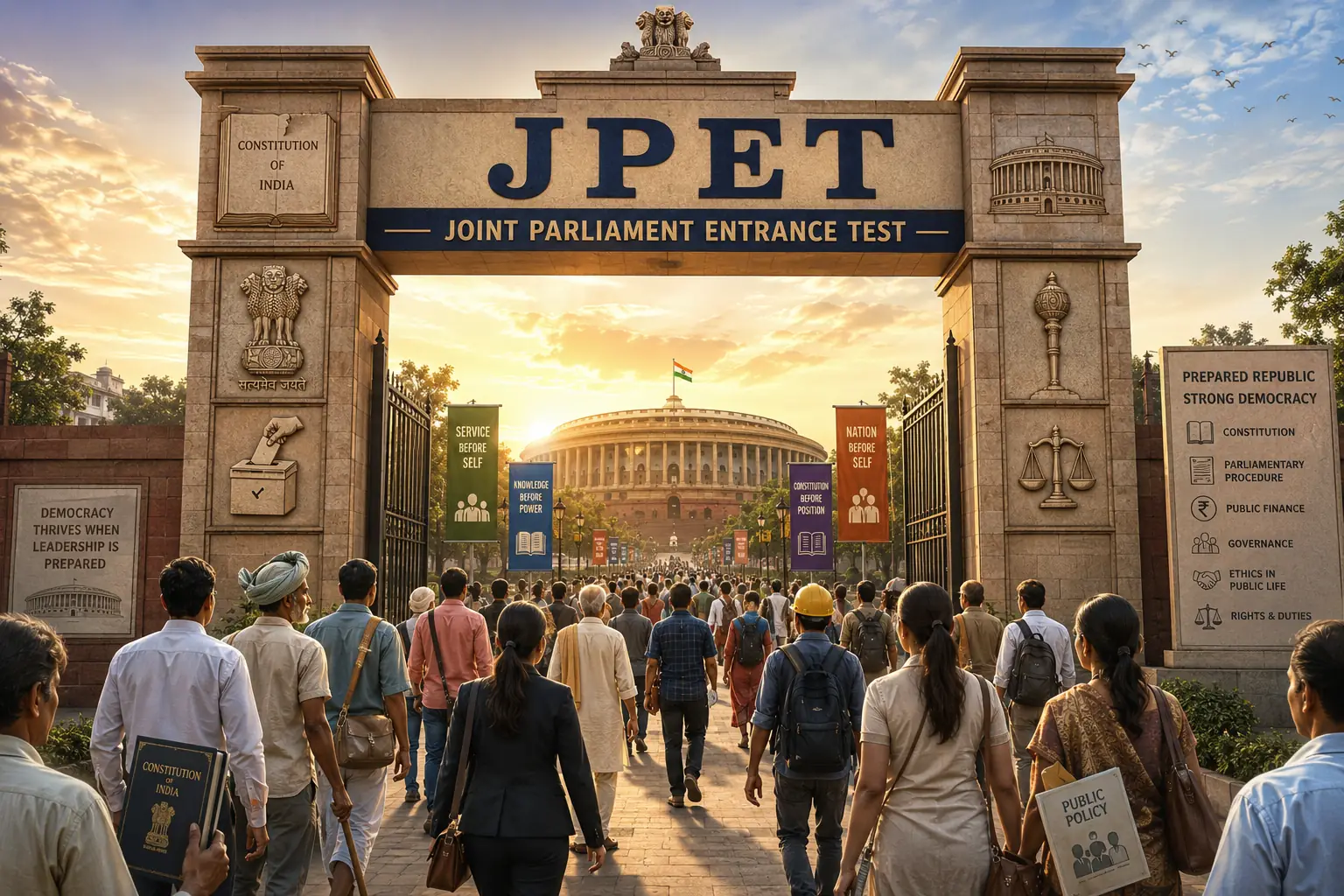
As India moves steadily toward the centenary of independence in 2047, perhaps the republic must begin asking difficult but necessary questions. Can we imagine a democracy where representatives continue to emerge from ordinary society but possess a foundational understanding of governance before entering Parliament and legislative assemblies? This is not a call for elitism or exclusion. It is a call for preparation. The proposal may sound unconventional, but a Joint Parliament Entrance Test (JPET) deserves intellectual discussion.
The idea of JPET is not to create academic politicians or remove grassroots leadership from public life. India’s democratic strength lies precisely in allowing voices from villages, labour movements, social struggles, and ordinary households to enter governance. Political wisdom cannot be measured entirely by degrees. However, governance in the twenty-first century increasingly demands familiarity with constitutional processes, public finance, policy implementation, and parliamentary conduct.
A modest qualifying examination could focus on practical civic knowledge rather than advanced theory. Basic understanding of the Constitution, rights and duties, parliamentary procedures, ethics in public office, governance structures, public administration, and national policy challenges may become areas of minimum competence. The objective would not be competition but qualification. Such a framework would affirm that public representation is open to all, but governance requires preparation.
Many would argue that such an idea threatens democratic accessibility. Critics may fear that examinations could privilege urban elites and marginalise leaders who possess lived experience but limited formal education. These concerns are valid and must remain central to any discussion. Yet examinations themselves need not become instruments of exclusion. If designed in multiple languages, affordable formats, flexible attempts, and practical evaluation methods, such a system could remain democratic while improving institutional quality.
India’s political history itself demonstrates that extraordinary institutional changes often begin as impossible conversations. Across decades, debates once dismissed as unrealistic eventually transformed into policy realities through constitutional mechanisms, political will, and public participation. Whether one looks at major national reforms or difficult constitutional decisions, history repeatedly reminds us that democratic imagination matters. Therefore, discussing preparedness in politics should not be dismissed merely because it challenges convention.
At a philosophical level, democracy was never intended to celebrate ignorance. Democracy emerged as a system that trusted citizens and encouraged civic maturity. If citizens increasingly educate themselves to participate in modern society, perhaps public representatives should also embrace structured learning. A Parliament is not merely a theatre of speeches and symbolic gestures. It is the institution where laws are framed, budgets are shaped, and the future of generations is negotiated.
India is no longer a fragile postcolonial democracy struggling for survival. It is a confident republic with growing literacy, expanding institutions, and global responsibilities. The aspiration for developed nation status cannot depend only on infrastructure and economic growth. It must also include institutional refinement and political capability. Public trust deepens when governance reflects both popular legitimacy and procedural understanding.
The answer may not necessarily be JPET, and perhaps the proposal itself will evolve into other forms of political training or certification. Yet the question remains powerful and unavoidable. If every important sphere of national life values preparation before responsibility, should politics remain entirely exempt from such reflection? As India approaches 2047, strengthening democracy may require not less participation but better prepared participation. A mature republic is not measured only by who governs, but by how deeply governance understands the nation it seeks to lead.