
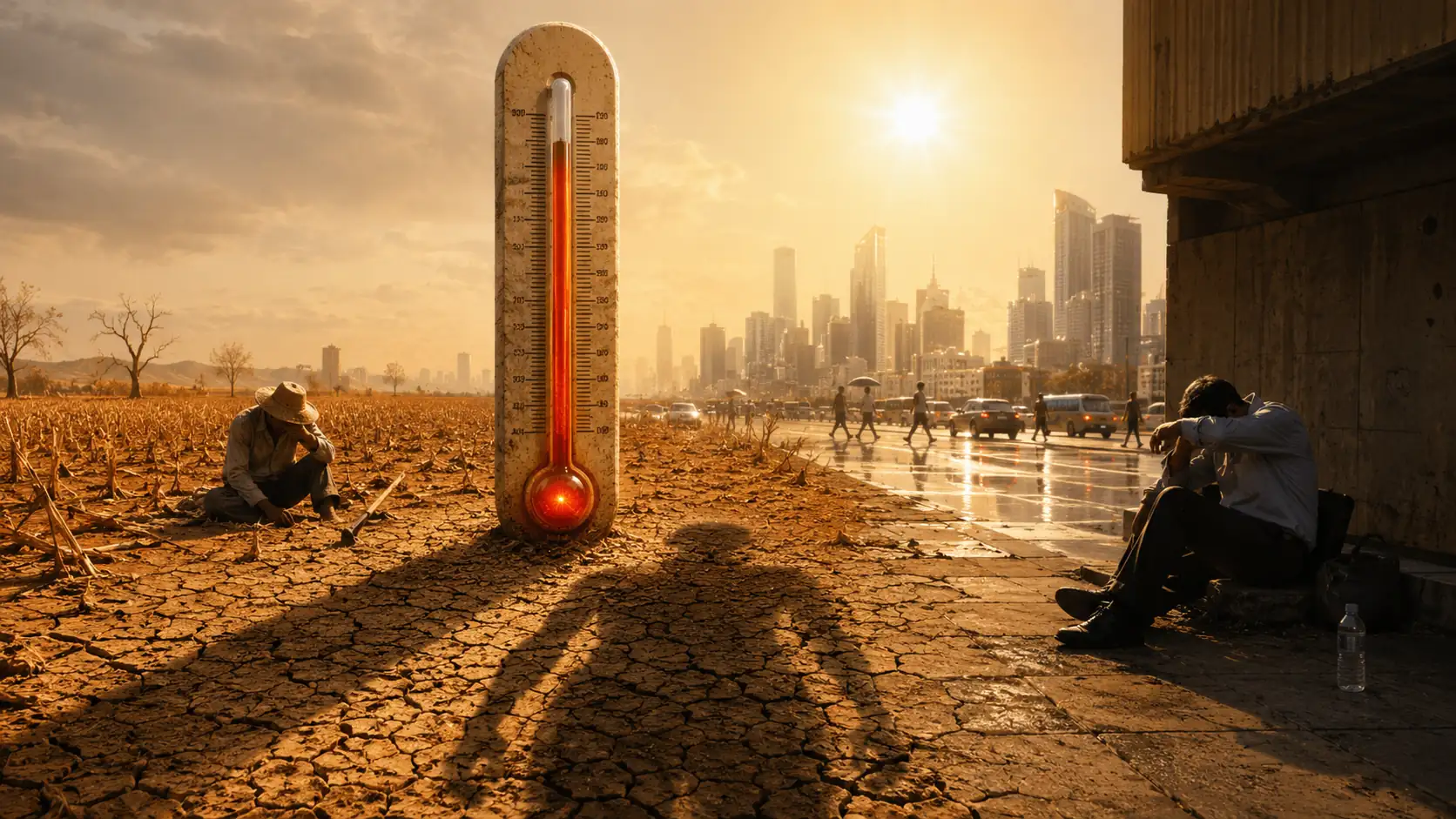
The thermometer does not lie. Across continents — from the plains of Rajasthan and Odisha to the cities of Spain and Turkey, from the agricultural fields of Bihar to the forests of Brazil — the summers of recent years have delivered an unmistakable message: the climate crisis is no longer a future threat. It is a present reality unfolding in degrees Celsius.
Heatwaves, once considered rare meteorological events, have become recurring features of modern life. They are lasting longer, occurring more frequently, affecting larger populations, and causing unprecedented damage to human health, agriculture, ecosystems, and economies. What was once a seasonal inconvenience has evolved into one of the deadliest manifestations of climate change.
The question is no longer whether heatwaves will occur. The question is how prepared societies are to survive them.
A World Under Extreme Heat
The year 2025 marked another alarming milestone in Earth’s warming trajectory. According to the World Meteorological Organization’s (WMO) State of the Global Climate 2025 Report, virtually every region of the world experienced above-normal temperatures, while more than 90 percent of the global oceans witnessed at least one marine heatwave. These oceanic heat events disrupted fisheries, damaged coral reefs, altered weather patterns, and intensified climatic extremes across the globe.
The impacts were visible everywhere. Across South Asia, temperatures surged 5–8°C above seasonal averages as early as April, weeks before the traditional peak summer season. Rajasthan’s Sri Ganganagar recorded temperatures approaching 48°C, exposing millions of people to dangerous levels of heat stress. Similar conditions were reported across large parts of northern, central, and eastern India, highlighting the growing intensity and geographical spread of heatwaves.
Europe experienced some of its hottest conditions ever recorded. In July 2025, Silopi in Turkey registered an unprecedented 50.5°C. Portugal and Spain shattered national temperature records, with temperatures crossing 46°C. According to assessments by the World Weather Attribution Network, approximately 16,500 deaths across Europe were linked to extreme heat, with nearly two-thirds attributable to human-induced climate change.
These are not isolated incidents. They are symptoms of a planet undergoing rapid climatic transformation.
India’s Silent Heat Emergency
India is among the world’s most heat-vulnerable nations. Its large population, tropical climate, dependence on outdoor labour, and significant socioeconomic inequalities create a perfect storm of vulnerabilities.
While the India Meteorological Department (IMD) defines a heatwave based on deviations from normal temperatures, the real story lies in its human consequences.
A landmark study by Narang and Gadgil (2026), published in Frontiers in Environmental Health, estimates that a single day of extreme heat can result in approximately 3,400 excess deaths nationwide. A severe five-day heatwave may cause nearly 30,000 excess deaths. The study further reveals that the 100 most vulnerable districts account for 44 percent of projected heat-related mortality despite containing only 31 percent of India’s population.
Perhaps the most striking finding is that Uttar Pradesh, Bihar, Madhya Pradesh, Rajasthan, and Gujarat account for nearly two-thirds of projected heatwave deaths while contributing only 29 percent of India’s GDP. Heatwaves therefore expose not only climatic vulnerability but also deep socioeconomic inequalities.
Heat is no longer merely an environmental challenge. It is increasingly a development, health, and social justice issue.
Although official heat-related deaths reported by government agencies have declined significantly due to improved forecasting and preparedness, public health experts caution that actual mortality remains substantially underreported. Many heat-induced cardiac, respiratory, and renal complications are seldom captured in official statistics. According to the National Centre for Disease Control (NCDC), more than 7,000 suspected heat-stroke cases were reported during 2025 alone.
The result is a silent public health crisis unfolding across the country.
Odisha at the Frontline of Climate Risk
For Odisha, the challenge is becoming increasingly acute.
Districts such as Sambalpur, Boudh, Balangir, Subarnapur, Angul, Jharsuguda, Sundargarh, and Nuapada frequently experience temperatures exceeding 45°C during summer. At the same time, rapidly urbanising centres such as Bhubaneswar, Cuttack, Rourkela, and Sambalpur are experiencing the growing effects of the Urban Heat Island phenomenon, where concrete surfaces, asphalt roads, and declining green cover trap heat and elevate local temperatures.
The consequences extend far beyond discomfort. Agricultural labourers, construction workers, street vendors, sanitation workers, traffic personnel, and daily wage earners face prolonged exposure to hazardous heat conditions. Women engaged in agriculture, livestock management, and water collection often bear a disproportionate burden. Children, elderly citizens, and people with pre-existing health conditions remain particularly vulnerable.
Odisha, a national leader in implementing heatwave action plans, must now transition from seasonal response to long-term climate resilience through climate-sensitive urban planning, water conservation, afforestation, livelihood diversification, and climate-resilient agriculture.
Heat’s Hidden Economic Cost
Heatwaves are not merely public health emergencies; they are economic disasters.
The joint FAO-WMO Report on Extreme Heat and Agriculture (2026) estimates that extreme heat causes the loss of nearly half a trillion work hours globally every year. More than 1.2 billion workers are exposed to heat stress annually.
For countries like India, where millions depend on outdoor occupations, every hour lost to extreme heat translates into reduced productivity, lower incomes, and heightened vulnerability. For informal workers, a missed day of work often means a missed day’s meal.
Scientific studies published in Nature Communications suggest that human-induced heat extremes have already reduced global economic output by trillions of dollars over recent decades, with poorer regions suffering disproportionately.
The Thermometer as a Mirror
Heatwaves are often described as natural disasters. Increasingly, they are becoming human-amplified disasters shaped by climate change, inequality, and inadequate preparedness.
The science is clear. The warnings are unmistakable. The impacts are already visible in hospitals, farms, workplaces, and households across the world.
The thermometer has become a mirror reflecting our collective choices — how we build cities, manage water resources, protect vulnerable populations, and respond to the climate crisis.
For Odisha and India, the challenge is not merely to survive hotter summers but to build resilient communities capable of thriving in a warming world. Heatwaves are no longer seasonal anomalies. They are among the defining development challenges of the twenty-first century.
The heatwave is no longer simply a weather event. It is a test of governance, equity, resilience, and political will.
And it is a test that can no longer be postponed.