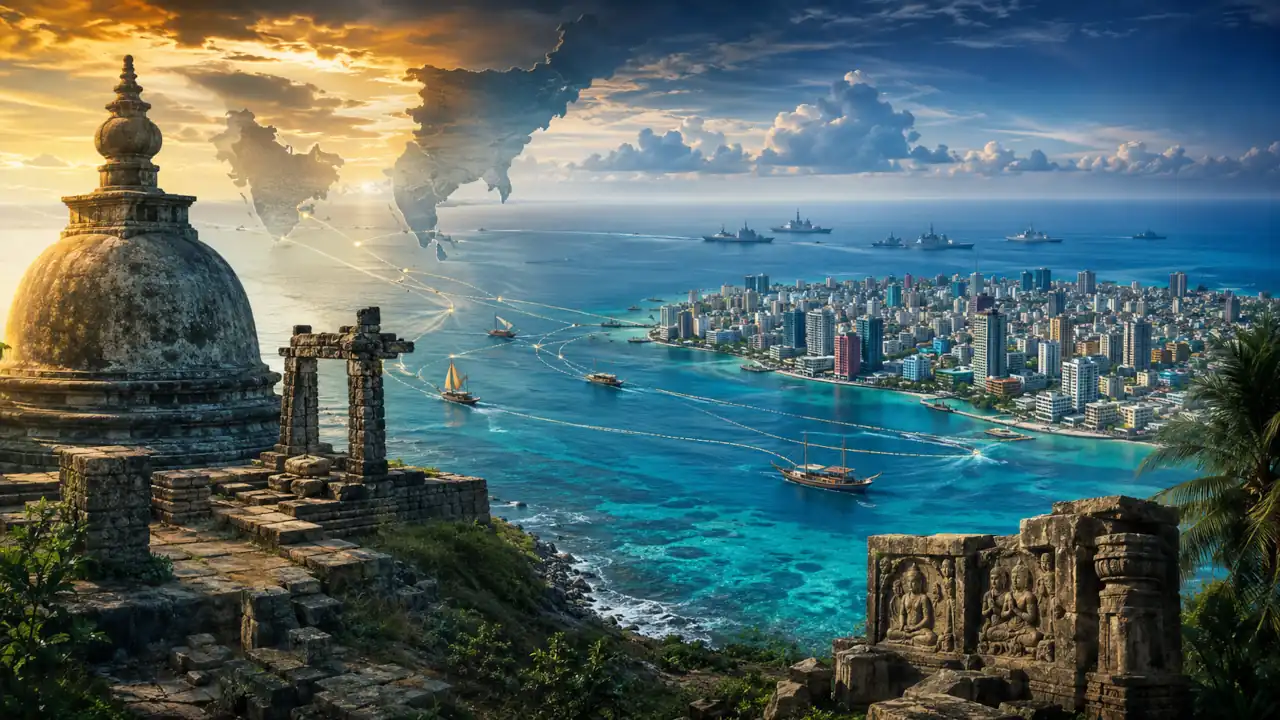
AROUND the time the Jagannath Temple in Puri was being constructed beginning 1112 CE under King Anantavarman Chodaganga Deva, other parts of the subcontinent were witnessing very disturbing and transformative events. The Northwest region of Hindustan was being attacked and ravaged by a series of Muslim invaders like the Ghazni, Khalji, Ghori and Iltutmish. And Maldives, an archipelago of islands barely 700 kms off the coast of Kerala (Andaman is over 1,400 kms off Indian mainland, just to give a perspective) was witnessing a similar transition.
Prior to Islam, the Maldives practiced Buddhism for over a thousand years, intertwined with local animistic beliefs. Buddhism was introduced around the 3rd century BCE and remained the predominant religion until the 12th century CE, when Islam became the dominant faith. Traders from the Arabian Peninsula gradually influenced the local population with their religious beliefs, introduced Islamic principles and practices, paving the way for the eventual conversion of the ruling elite and subsequently, the general population.
But first, how did Buddhism reach Maldives? According to a legend of the Maldivian folklore, a prince named Koimala from the North (Ihavandhu), India or Sri Lanka entered the Maldives around the 3rd century BCE and became the first king from the House of Theemuge. So Buddhism may have come to Maldives from either Sinhala (Sri Lanka) or Kerala. How did Buddhism reach these two regions nearly three centuries after its founding in 528 BCE?
Kalinga began trade with Sinhala (Sri Lanka) around the 3rd century BCE. This maritime trade was significant during the Maurya Empire, particularly under the rule of Kharavela, who established strong trade relations with regions including Sri Lanka. The founder of the Sinhalese race, as mentioned in the Mahavamsa, was an Odia (Kalinga). This relationship lasted for over 1,700 years, with Kalinga playing a significant role in popularizing Buddhism in Sri Lanka and introducing Vajrayana Buddhism. The Abhayagiri monastery in Sri Lanka is a testament to this connection, as it shares a deep cultural heritage with Kalinga.
Buddhism also reached Kerala around the 3rd century BCE. The Chera rulers, referred to as Keralaputras in Ashokan inscriptions, are believed to have supported Buddhist teachings and monasteries, promoting the religion in the region. Archaeological evidence, such as Buddha statues from Alappuzha, Kollam, and Karumadi, and inscriptions at ancient ports like Pattanam, indicate a thriving Buddhist presence during the period.
Going by these connected timelines, excavations and inscriptions of those times and folklore that still survive to this day, a broader connect between Kalinga, Sinhala, Kerala and further south to Maldives can be established. A DNA mapping would bolster an evidence-based anthropology.
Sir Vidiadhar Surajprasad Naipaul, the acclaimed author and Nobel laureate, embarked on a travel of four Islamic countries starting with Iran as it had just emerged after the Islamic Revolution led by Ayatollah Khomeini. Then he goes on to Pakistan, Malaysia and ends in Indonesia. He was interested in “converted peoples” and wanted to study cultures which have a long pre-Islamic history and their modern attempts to establish a religious state. On return to the UK, he wrote Among the Believers. Fifteen years later in 1995, he came out with a sequel, Beyond Belief: Islamic Excursions among the Converted Peoples, describing his five-month journey revisiting the same four Muslim countries.
Naipaul observed succinctly later in his autobiography that having changed faith somewhere between the seventh and eleventh century, he sees these converts as rejecters of their indigenous belief, engaged in “a dreadful mangling of history”, and suffering from resultant “neurosis”. Conversion to Islam and the ensuing emphasis on foreign holy places is for him “the most uncompromising kind of imperialism”. He does not consider the possibility that Islam might, over the centuries, have become an indigenous religion.
Naipaul had skipped Maldives, maybe because of its tiny population. Otherwise he would have observed the same traits. The first signs of radical Islam penetrating the island came nearly four decades back on the night of November 3, 1988. A desperate phone call from then Maldives President Maumoon Abdul Gayoom informed India that armed radical mercenaries had stormed the capital, Male, and were attempting to overthrow his government. Within hours, India responded with one of the fastest overseas military operations involving Indian paratroopers, military transport aircraft, naval warships and an overnight race across the Indian Ocean to prevent a coup from succeeding.
Organised jihadist networks of the Pakistan-based Lashkar-e-Taiba (LeT), Al Qaeda and other terrorist groups operate in Maldives. In the past decade, a “religious revival” by Salafists, Wahhabists and other fundamentalists has swept through the islands. Since 2014, Saudi Arabia has pledged millions for Islamic programs, schools and mosques. Maldivians have also received scholarships to study Islam in madrasas in Pakistan and Saudi Arabia, returning home with a more fundamentalist interpretation of the Quran. In a 2015 poll, 90 percent of Maldivians agreed that flogging, stoning to death, the death penalty and amputation of the arms should be implemented.
With one third of the country’s population living in the densely populated capital city of Male, the result has been “inevitable societal ills such as gang culture, drug abuse, unemployment, radicalization, political violence and a widening socio-economic gap.” Radicalized gang members have physically assaulted, abducted or murdered Maldivians who they perceived to be committing un-Islamic acts, including moderate clerics, political figures, journalists and bloggers. An estimated 200 Maldivians, one in 2,000 people on the islands, have reportedly joined ISIS in Iraq or Syria.
About 2 million tourists visited the islands last year for a population of just 400,000, yielding $5.7 billion, a third of the country’s gross domestic product. Just to get a perspective, about 20 million foreign tourists arrived in India in 2024 for a population of 1.42 billion. Maldivian government officials say there is no threat to tourists. A former Maldivian president claimed extremists won’t stage attacks against the tourist industry because they launder money through it.
The China-Pakistan nexus to counter India’s influence was manifest in the victory of Mohamed Muizzu in September 2023, who won campaigning on an “India-Out” slogan. While the strained relations may have been somewhat repaired, the threat is clear and present.
As history suggests, we are closer than we think. A clanship established over two millennia back may have been whitewashed but a revival of the connect can be a distinct possibility.