
It was a routine Tuesday morning for us in New Delhi on September 11, 2001. I had just been selected for deployment as the Chief Humanitarian Officer of the UN Interim Force in Lebanon and was advised to attend as many seminars and round-tables in Delhi’s amazing array of think-tanks and research centres. The United Services Institute (USI) was holding a round-table on Tactical Nuclear Weapons (TNW), a subject popular with nuclear use theorists (colloquially called NUTs).
I was eager to participate in the round-table since TNWs, or battlefield nuclear weapons like nuclear artillery, atomic demolition munitions, nuclear mines, torpedoes and short-range missiles, were being showcased as a way of reining in ‘mutual assured destruction’ (MAD) scenarios by bringing the war back into the battlefield with low-yield warheads against military targets.
But all prepared scripts and presentations were suddenly made redundant by a chain of events that morning. American Airlines Flight 11 struck the North Tower of the iconic World Trade Centre of New York City at 8.46 am on September 11, 2001. At first, television anchors and people watching from the streets struggled to understand what they had seen. The possibility of an accident remained alive for 17 minutes. Then Flight 175 entered the South Tower. The second impact ended uncertainty.
America’s mainland was under attack, something that it had escaped during the two world wars, protected as it was by two mighty oceans, the Pacific and the Atlantic. The 9/11 spectacle was designed for live television. The first strike attracted the cameras. The cameras carried the second strike around the planet.
The attacks killed 2,977 people from more than 90 countries. Five days later, US President George W. Bush first used the term “war on terrorism” on September 16, 2001, and then “global war on terror” a few days later in a formal speech to Congress following the September 11 attacks. Thus was born the GWOT.
The US invaded Afghanistan in October 2001 after the Taliban refused to surrender Osama bin Laden and dismantle al-Qaeda’s sanctuary. Bin Laden was eventually killed by US forces in Abbottabad, Pakistan, in May 2011.
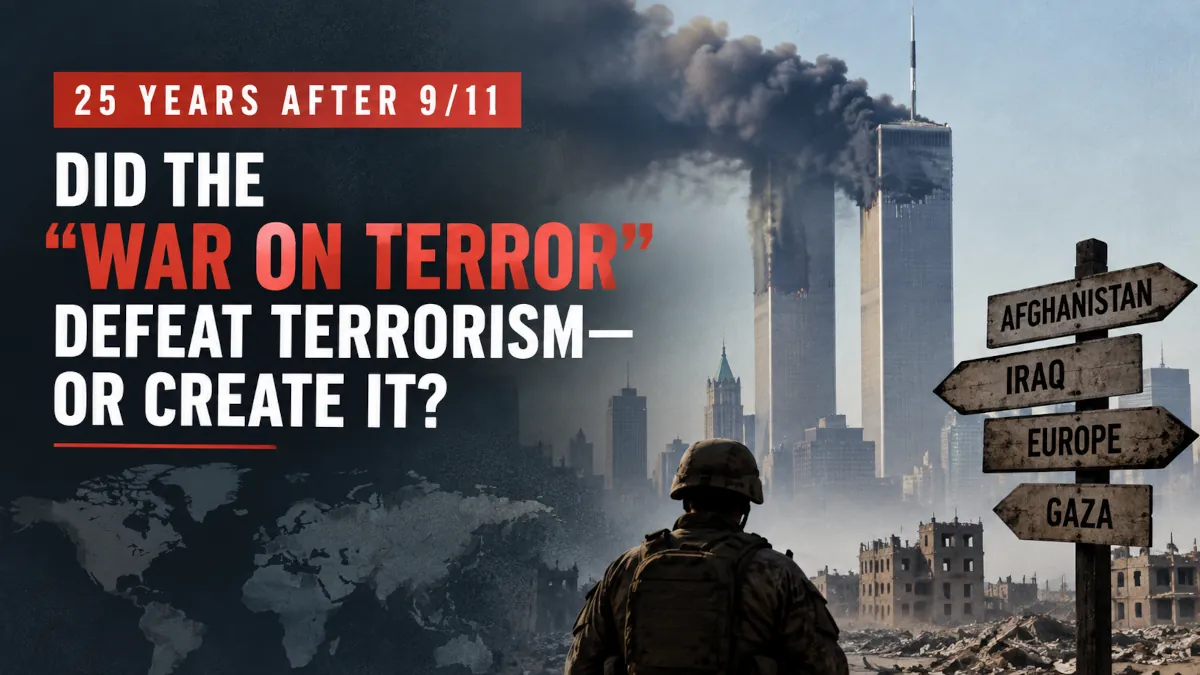
Twenty-five years since that fateful morning of September 11, 2001, the scars are omnipresent, in airport searches, mass surveillance, unfinished trials, toxic lungs, trillion-dollar wars and a generation that knows the attacks only through screens. Did America defeat the terror unleashed that morning, or merely inherit a different kind of fear?
It is important to recount that 15 of the 19 terrorists involved were citizens of Saudi Arabia. Out of the 61 groups that are designated as terrorist organisations by the US State Department, the overwhelming majority are Wahhabi-inspired and Saudi-funded groups, with a focus on the West and Iran as their primary enemy. Other than a handful of Shia groups like Hezbollah and Hamas, Wahhabism remains the source of most radical Islamic extremism.
Yet, from Afghanistan to Iraq to Libya, Syria and Yemen, a host of other countries were bombed and decimated as part of the GWOT. It raises questions on what exactly GWOT aimed at and whether it has inflamed Islamic fundamentalism rather than snuff it out. The misdirected US-led GWOT has pushed millions of migrants from war-torn Afghanistan, Iraq, Syria and North Africa into the heart of Europe and sowed the seeds of ferment.
The hordes of migrants that swarmed Europe through Turkey, especially after the US-sponsored Arab Spring in 2010-11, have become the primary source of terror there. The disquiet in Europe is compounded by the fact that Islamic extremism has permeated quite deeply into these societies.
One outcome is the rise of the far-right in many countries across Europe. Germany is reeling from the biggest far-right victory last Sunday in a state election since the Nazi period after voters in Saxony-Anhalt gave the anti-immigration, pro-Kremlin Alternative für Deutschland (AfD) party a thumping first-place finish of 44%, just short of an absolute majority.
The global jihadist movement spawned by Osama bin Laden remains a threat, although it has evolved considerably. Al-Qaeda is back in Afghanistan, enjoying the safe haven and sanctuary provided by the Afghan Taliban, which took the country back in August 2021. Even with a somewhat reduced operational capacity, al-Qaeda’s intent to strike the West persists, and several of its affiliates are all serious threats to local, regional and international security.
As part of the GWOT, the US runs a global campaign using sophisticated armed drones and stealth bombers to assassinate people who the US government suspects of intending to harm it someday. The drone attacks no doubt kill hundreds of innocents in what it dismisses as collateral damage. Those that survive these close encounters are aggrieved and offer easy catchments for recruitment by jihadis.
Conditions in detention facilities like Abu Ghraib and Guantanamo Bay and displacement camps in Syria, Jordan and elsewhere are amplified for indoctrination. The ongoing war in Gaza will continue to have a radicalising effect on individuals worldwide, including university campuses and streets in the West.
From an Indian perspective, though, the picture is viewed differently. By the time the dramatic events of 9/11 triggered the US-led GWOT, India had been fighting its own war on Pakistan-sponsored terror for decades. The only difference was that the West, and especially the US, had refused to recognise the gravity of Pakistan’s use of terror as an instrument of state policy because of their own narrow geopolitical interests.
The launching of GWOT, from the Indian point of view, was just another chapter of a conflict it was already fiercely combating. It is barely a year since India launched Op Sindoor on May 7, 2025, as a retribution for the tragic Pahalgam massacre, which killed 26 people on April 22, 2025.
Twenty-five years on, while Afghanistan, which sheltered the al-Qaeda leadership, is back with the Taliban after 20 years of futile American occupation, Pakistan, which provided Bin Laden a safe sanctuary for almost a decade, is in deep embrace with Trump’s America, with its military chief being Trump’s ‘favourite Field Marshal’.
In May 2025, Trump had warmly greeted the new Syrian leader and former al-Qaeda fighter Ahmed al-Sharaa, who, under the nom de guerre Abu Mohammed al-Golani, rose through the ranks of al-Qaeda and fought US forces in Iraq before entering the Syrian war.