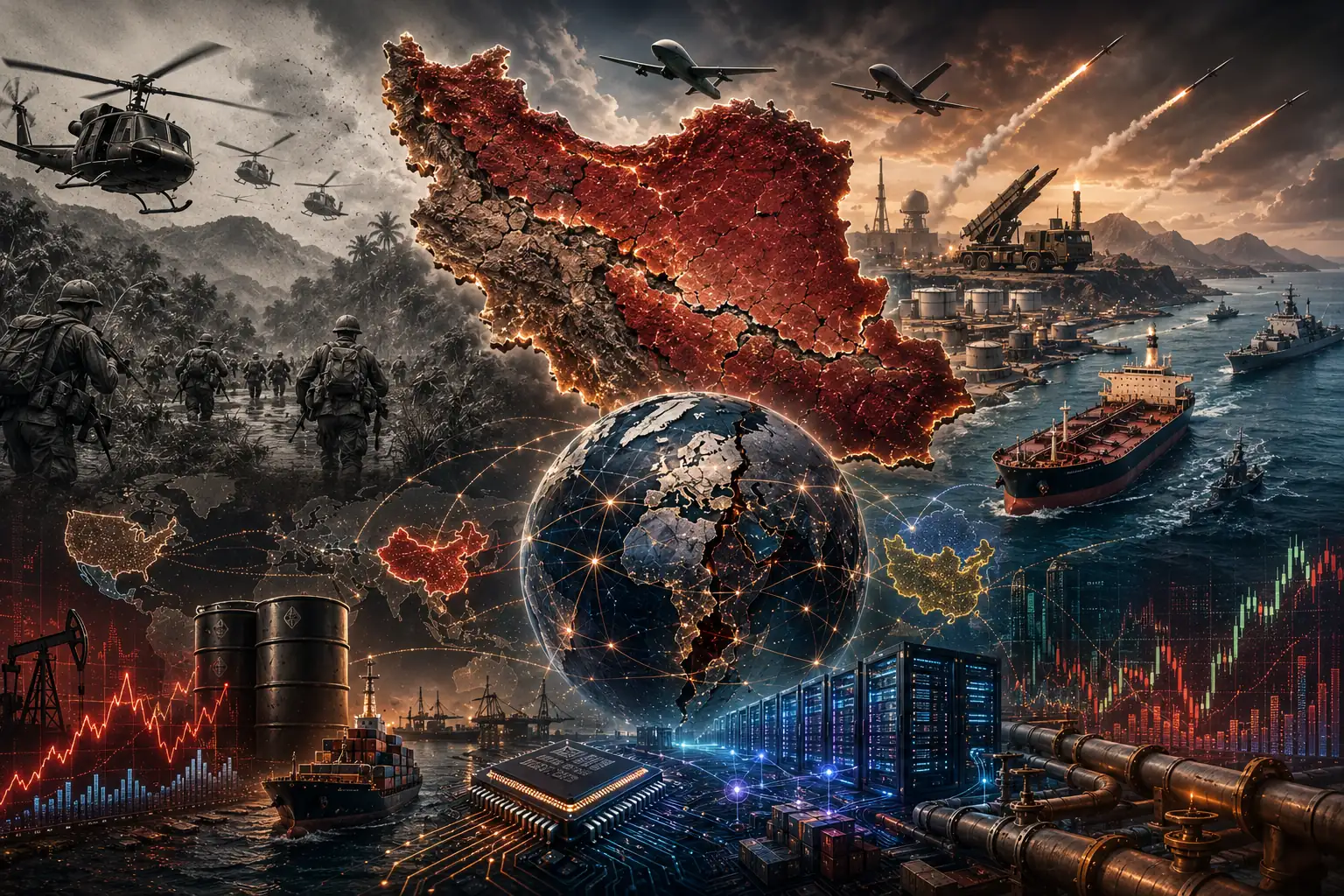
HALF a century back in 1975, Vietnam had emerged from the war as a potent military power within Southeast Asia, though its agriculture, business, and industry were disrupted, large parts of its countryside were scarred by bombs and defoliation and laced with land mines, and its cities and towns were heavily damaged. Many observers feel that likewise Iran will eventually emerge from the ongoing war with the US and Israel as the dominant military power in the Gulf though its cities are heavily damaged and its oil infrastructure seriously denuded by the heavy American-Israeli bombardments. Some term this war as America’s Vietnam moment.
Similarities are glaring, especially the generally anticipated end-state and hence the comparisons. Despite the overwhelming superiority of the American war machinery, the Viet Congs waged a debilitating combination of guerrilla warfare tactics including ambushes, sabotage, hit-and-run attacks, and the use of extensive tunnel networks to exhaust the American military might and the mounting casualties heavily influenced the anti-war public opinion back home to force a humiliating exit.
While the US inducted more than 5,00,000 military personnel by 1969 to the war effort in Vietnam, the Soviet Union and China poured weapons, supplies, and advisers into North Vietnam which in turn provided support, political direction, and regular combat troops for the campaign in the South. In the Iran war, the same two powers, Russia and China are arrayed against the US, supporting the Iran war efforts through an “Axis of Evasion” that includes integrated supply chains of dual-use technology to circumvent Western sanctions through which Iran is able to develop drones, navigation systems, and other military capabilities.
China supplies Iran with drones, anti-ship cruise missiles, surface-to-air missiles, and the components thereof, to aid in its aerial and maritime defence capabilities. Since 2022, Moscow and Tehran have exchanged drone technology and production know-how. As part of a deal, Iran transferred 600 disassembled Shahed-16 drones, components for 1,300 drones, training, and technical expertise to Russia to assist in its war in Ukraine. Russia is now supplying Iran with Russian-made Shahed drones to use in attacks against the US and Israel. Russia is also reportedly sharing satellite imagery to improve navigation and targeting based on its experience of using drones in Ukraine.
Another striking similarity is media and public reaction to the wars. The costs and casualties of the Vietnam war proved too much for the United States to bear, and U.S. combat units were withdrawn by 1973. In 1982 the Vietnam Veterans Memorial was dedicated in Washington, D.C., inscribed with the names of 57,939 members of US armed forces who had died or were missing as a result of the war. Now the huge losses to American military assets in the Gulf region is making the war hugely unpopular with mid-term elections looming.
However, the differences from the Vietnam situation are far more consequential than the similarities. Unlike the Vietnam war, the war in Iran has global economic and geopolitical consequences. Shipping through the Strait of Hormuz, the chokepoint through which roughly one-fifth of the world’s oil supply normally passes, has been severely disrupted. Oil prices briefly surged above $120 per barrel during the first phase of the war, triggering volatility across global financial markets. It stays elevated, hovering around $100 per barrel and spikes every time there is an exchange of drones and missiles.
Natural gas, for example, accounts for 70 to 80 percent of the variable cost of ammonia production for producers globally. The disruption removes not only LNG from the global market but also fertiliser produced in the Gulf, a region that accounts for about 30 percent of global ammonia exports and 35 percent of global urea exports, the bulk of which are routed through the Strait of Hormuz.
One of the most critical of these materials is helium, an essential component in semiconductor manufacturing processes used to cool equipment and support lithography systems that produce advanced microchips. Qatar produces more than one-third of the world’s helium supply, much of it extracted as a by-product of liquefied natural gas production. Industry experts estimate that more than 25 percent of the global helium supply stands disrupted.
The conflict also threatens to affect the economics of large-scale computing infrastructure. Modern artificial intelligence data centres require enormous amounts of electricity to operate. Rising energy prices could therefore slow the expansion of AI infrastructure projects.
The Iran war will disproportionately impact the Global South. Advanced economies absorb energy and freight shocks through fiscal cushions, reserve currencies and diversified suppliers. Developing economies absorb them through import compression, currency depreciation, fertiliser rationing and hunger. Food accounts for 44 percent of household expenditures on average in low-income countries compared with 16 percent in advanced economies.
The Iran war’s downstream inflation will land on countries across the Global South that are already operating with depleted legitimacy reserves, narrow fiscal space and citizens who have absorbed shock after shock since the pandemic. Some governments will not survive it. The trade and tourism disruptions following the Ukraine war directly triggered violent overthrow of governments in Sri Lanka, followed by Bangladesh and Nepal in the neighbourhood. The consequences of Iran war on energy, trade and geopolitical dynamics would be far more prolonged and overarching.
The end-state is nowhere in sight, the war having just entered another violent phase over the weekend breaking a long spell of relative calm under a tenuous ceasefire agreed to in April, but the direction is not difficult to postulate. Progressively, the US finds itself staring at a humiliating situation with Iran literally dictating the terms of the endgame even as sections of the US media and President Donald Trump’s Truth Social posts attempt to depict a starkly different picture.
Wars do not end when the missiles stop flying. They end when the structural damage they inflict on the global trading system finishes working its way through prices, contracts, balance sheets and political legitimacy. The American queue up before soup kitchens during the Great Depression of 1929. The collapse of petrodollar on which a whopping $39 trillion of US debt is resting, may see history repeating itself a century on. Today, US stands isolated even from its closet allies across the Atlantic and its immediate neighbours Canada and Mexico. The US rode out of Vietnam war consequences by delinking dollar from gold standards and introducing the petrodollar regime. Iran is not Vietnam.