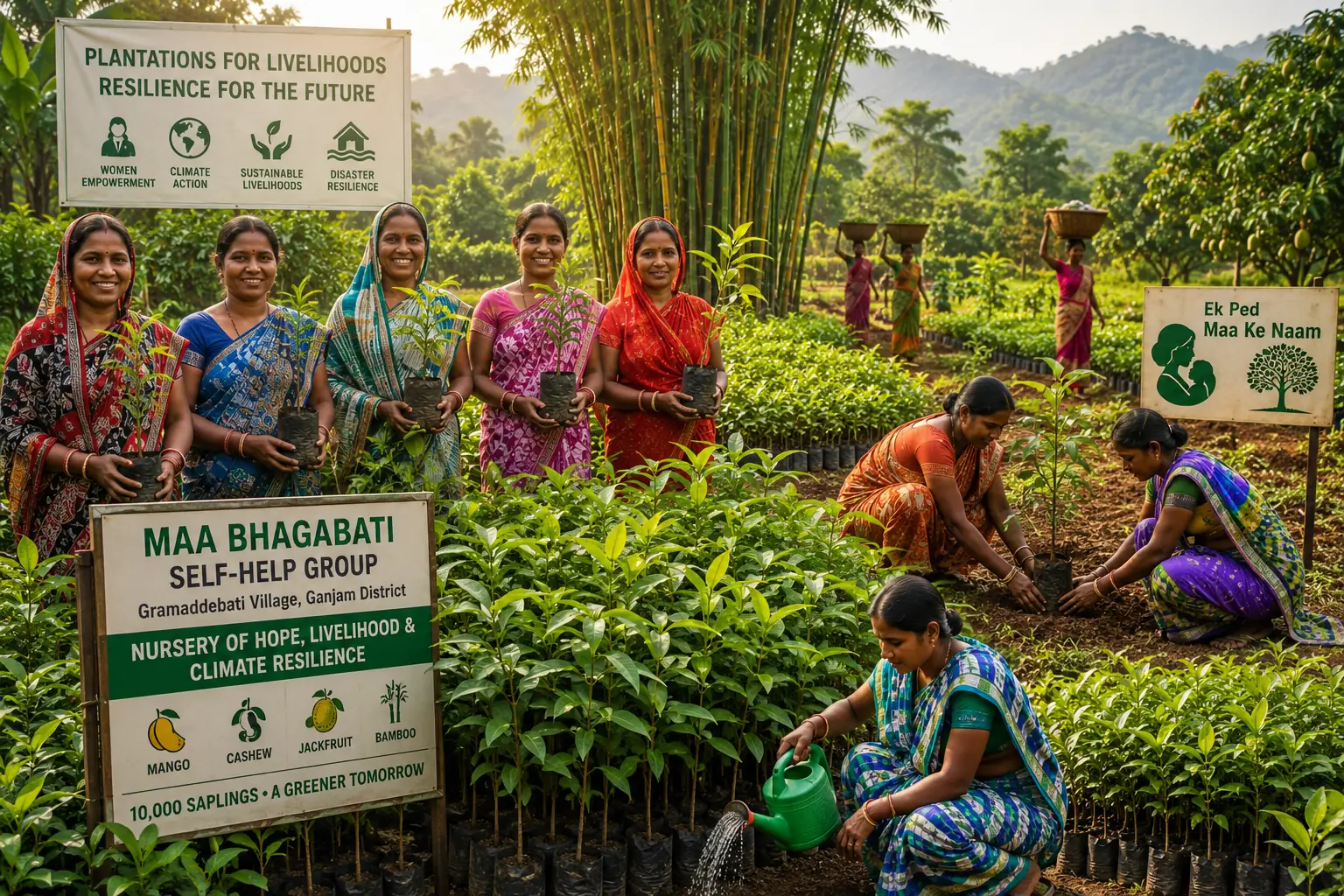
Across Odisha, a quiet green revolution is taking shape. Women are transforming plantations into engines of livelihood generation, environmental conservation, and disaster resilience.
In Gramadebati village of Ganjam district, twelve women of the Maa Bhagabati Self-Help Group (SHG) responded to rising temperatures, water scarcity, and declining farm incomes by establishing a nursery of nearly 10,000 mango, cashew, and jackfruit saplings. The initiative created income, improved local access to planting material, and demonstrated how ecological restoration can strengthen rural livelihoods.
Their story reflects a broader reality: plantation-based livelihoods offer one of the most effective pathways to simultaneously advance women’s empowerment, climate action, and sustainable development.
The movement aligns with Prime Minister Narendra Modi’s “Ek Ped Maa Ke Naam” campaign, which encourages citizens to plant a tree in honour of their mothers. Across Odisha, women-led plantations are turning this vision into a practical model of livelihood creation and environmental stewardship.
Odisha’s Green Advantage
With nearly one-third of its area under forest and tree cover, Odisha possesses rich natural resources, including sal and teak forests, bamboo reserves, fruit orchards, medicinal plants, and India’s second-largest mangrove ecosystem.
At the same time, the state faces recurring cyclones, floods, droughts, and heatwaves. Women, particularly in tribal and rural communities, often bear the greatest burden of these challenges. Yet they are also among the state’s most important environmental stewards, actively engaged in forestry, agroforestry, sericulture, bamboo processing, nursery development, and forest-based livelihoods.
Plantation Economy: A Pathway to Women’s Empowerment
Plantation-based livelihoods create diverse income opportunities for women.
- Nursery enterprises provide year-round employment while supporting horticulture, forestry, and urban greening programmes.
- Cashew cultivation and processing employ thousands of women, with significant potential for value addition and market-led income enhancement.
- Sericulture continues to support rural households through silkworm rearing, reeling, and weaving activities, largely led by women.
- Kendu leaf collection and other forest-based activities remain important seasonal sources of income for tribal communities.
Bamboo: Odisha’s Green Gold
Among all plantation resources, bamboo offers exceptional opportunities for inclusive growth.
Widely available across Kandhamal, Koraput, Rayagada, Sundargarh, Mayurbhanj, and Malkangiri, bamboo supports enterprises ranging from furniture and handicrafts to packaging materials and eco-friendly alternatives to plastic.
Beyond livelihoods, bamboo grows rapidly, absorbs carbon, conserves soil and water, and restores degraded lands. Investments in bamboo plantations and processing can create thousands of green jobs while strengthening environmental sustainability.
Agroforestry: Farming for the Future
Agroforestry integrates trees with agriculture, creating multiple income streams while improving soil fertility, water conservation, and climate resilience.
Fruit trees, bamboo, timber species, and medicinal plants can help farmers diversify incomes and reduce vulnerability to climate shocks. For women farmers, agroforestry provides additional economic opportunities while enhancing household food and nutritional security.
VB-G RAM G (Previously MGNREGA) and Green Employment
The Viksit Bharat-Guarantee for Rozgar and Ajeevika Mission (Gramin) [VB-G RAM G] offers significant opportunities to strengthen plantation-based livelihoods.
Its focus on afforestation, water conservation, land development, and natural resource management can support community nurseries, fruit orchards, bamboo plantations, agroforestry systems, mangrove restoration, and climate-resilient village infrastructure.
When implemented through women-led SHGs, these investments can create long-term livelihood assets alongside employment opportunities.
Urban Women and the Green Economy
The plantation economy is no longer confined to rural areas.
Urban women are increasingly involved in floriculture, ornamental nurseries, bamboo handicrafts, herbal products, eco-tourism, landscaping, and sustainable retail businesses.
Growing demand in cities such as Bhubaneswar, Cuttack, Berhampur, Sambalpur, and Rourkela presents new opportunities for rural-urban green value chains that connect producers with expanding markets.
Plantations as Natural Disaster Shields
Plantations provide more than livelihoods; they protect communities from disasters.
- Mangroves reduce cyclone and storm-surge impacts along Odisha’s coastline.
- Agroforestry improves groundwater recharge and drought resilience.
- Bamboo plantations stabilise slopes and prevent soil erosion.
Households with diversified plantation-based incomes often recover more quickly from disasters due to greater economic resilience.
Supporting National and Global Goals
Women’s participation in plantation economies contributes to:
- Economic empowerment
- Livelihood diversification
- Biodiversity conservation
- Climate action
- Sustainable land management
- Disaster risk reduction
These efforts directly support the Sustainable Development Goals (SDGs), particularly:
- SDG 5 – Gender Equality
- SDG 8 – Decent Work and Economic Growth
- SDG 13 – Climate Action
- SDG 15 – Life on Land
The Way Forward
To unlock the full potential of plantation-based livelihoods, Odisha should:
- Expand women-led nursery enterprises.
- Promote bamboo-based industries and value chains.
- Strengthen agroforestry initiatives.
- Support women-owned processing and marketing enterprises.
- Enhance access to green credit and climate finance.
- Integrate women into mangrove restoration and disaster resilience programmes.
- Develop stronger rural-urban green supply chains.
When Women Plant Trees, Communities Prosper
The women of Gramadebati planted 10,000 saplings, but their contribution goes far beyond trees. They planted livelihoods, resilience, and hope.
Across Odisha, similar stories are emerging from bamboo clusters, agroforestry farms, sericulture centres, and mangrove restoration sites. Together, they demonstrate that plantations are not merely environmental interventions; they are powerful instruments of economic empowerment and sustainable development.
As the spirit of “Ek Ped Maa Ke Naam” inspires millions across India, Odisha’s women are showing that every tree can become a source of income, climate resilience, and community prosperity. The future of Odisha’s green economy will be shaped not only by the trees that are planted, but by the women who nurture them.