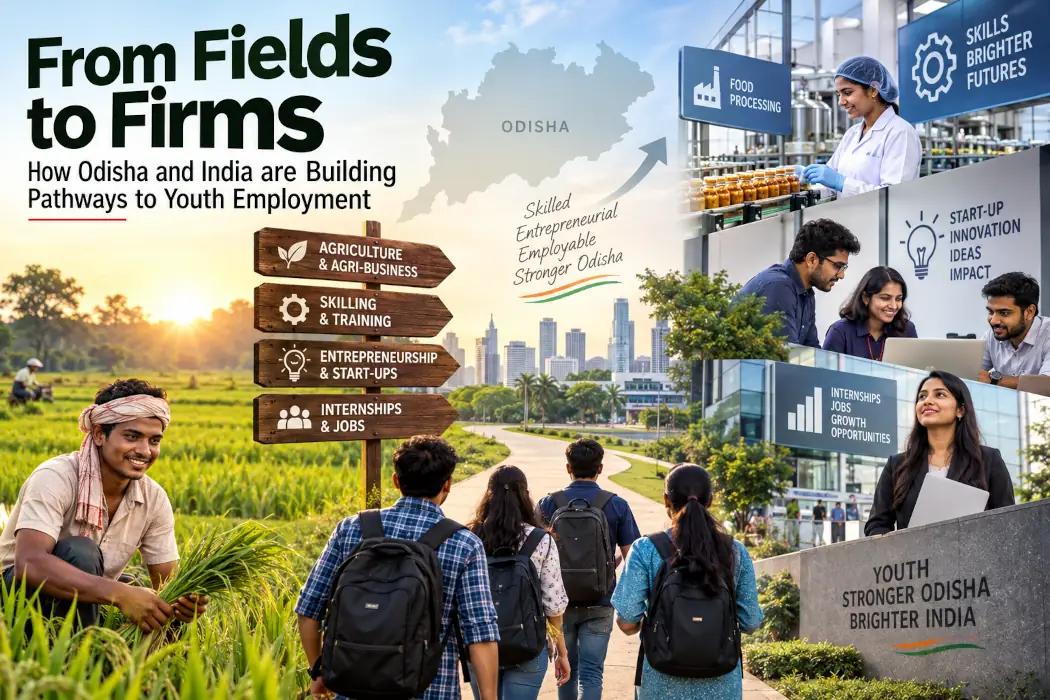
For a young person leaving college, an ITI or a skill-training centre in Odisha today, the choice is no longer limited to farming or waiting for a government job. New opportunities are emerging in agri-business, self-employment, start-ups, apprenticeships, internships and skill-based employment.
Yet the challenge remains significant. According to the Periodic Labour Force Survey (April-June 2026), unemployment among Odisha’s youth (15-29 years) stands at 17.2%, compared with 15.9% nationally. Urban young women face an even steeper challenge, with unemployment at 34.1%.
These figures underline a key reality: Odisha has a large pool of young people willing to work, but stronger pathways are needed to help them move from education and training into productive employment. Encouragingly, both the Odisha and Union Governments have developed a range of schemes supporting agriculture, entrepreneurship, start-ups and skilling. The next step is to connect these initiatives into a seamless employment ecosystem.
Agriculture as an Enterprise
Agriculture continues to be a major livelihood source in rural Odisha. Enhancing farm incomes and creating jobs around agriculture should therefore remain central to the state’s youth employment strategy.
The Mukhyamantri Krushi Udyog Yojana (MKUY), recently extended for 2026-31 with an outlay of ₹2,496.40 crore, aims to promote commercial ventures across agriculture, horticulture, fisheries, animal resources and food processing. Around 8,500 projects are proposed during this phase.
Such investments generate employment not only on farms but also in food processing, storage, packaging, transportation, dairy, poultry and fisheries. National initiatives such as the PM Formalisation of Micro Food Processing Enterprises (PM-FME) scheme and the Agriculture Infrastructure Fund further strengthen this ecosystem through credit support and infrastructure development.
The objective should be clear: move young people from farming for survival to farming as a profitable enterprise.
Enabling Youth Entrepreneurship
Not every young person seeks a salaried job. Many aspire to start businesses but require affordable finance, mentoring and market access.
Odisha’s SWAYAM scheme supports eligible youth with interest-free loans of up to ₹1 lakh for small enterprises, while national programmes such as Pradhan Mantri MUDRA Yojana, Stand-Up India and CGTMSE expand access to formal credit.
However, finance alone is insufficient. First-generation entrepreneurs also need assistance with business planning, registrations, licensing, bookkeeping, digital payments and market linkages. Government-supported enterprises should therefore receive “credit-plus-handholding” support during their initial years, improving their chances of survival and growth.
Building a Start-up Ecosystem
Through Startup Odisha, the state is nurturing innovation by providing incubation support, sustenance allowances and assistance for product development and marketing.
Additional incentives are available for eligible women, transgender and socially disadvantaged founders. The state’s Fund of Funds, with a target corpus of ₹100 crore, seeks to strengthen the ecosystem and support approximately 5,000 start-ups.
This is important because future employment growth will come not only from large industries but also from technology firms, rural enterprises, social ventures and digital businesses.
To maximise impact, these opportunities must extend beyond Bhubaneswar. Young entrepreneurs in districts such as Koraput, Kandhamal, Sambalpur and Balasore should have equal access to mentoring, incubation, finance and markets without needing to relocate.
Skills That Lead to Employment
Skilling is effective only when linked to market demand. Odisha’s investments in upgraded ITIs, Centres of Excellence, AI laboratories and advanced training institutions are helping build a stronger workforce. The state’s performance at IndiaSkills 2026, where it secured 57 medals, reflects this growing potential.
National programmes such as the Skill India Mission, PM Vishwakarma and the Prime Minister Internship Scheme (PMIS) further strengthen employment pathways. PMIS aims to provide one crore internships over five years through leading companies, offering a monthly stipend of ₹5,000 and one-time assistance of ₹6,000.
The focus, however, should shift from issuing certificates to ensuring employment, higher earnings and long-term career progression.
What Should Come Next?
The next phase of Odisha’s youth employment strategy should focus on five practical priorities:
1. Create a unified Youth Employment and Enterprise Portal that matches individuals with relevant schemes, training programmes, loans, internships and jobs through a single interface.
2. Establish district-level Youth Enterprise Facilitation Centres to support business planning, access to finance, registrations, mentoring and market connections, particularly in rural and tribal districts.
3. Prioritise women’s employment through safer transport, affordable childcare, flexible work arrangements, women-friendly industrial spaces and jobs closer to residential areas.
4. Strengthen employer linkages in skill programmes by measuring apprenticeship, placement, retention and income outcomes rather than training numbers alone.
5. Measure outcomes, not expenditure, by publishing district-wise data on enterprises created, jobs generated, women beneficiaries, loan performance and income improvements.
Connecting the Pieces
Odisha already possesses many of the building blocks of a strong youth employment system: agri-enterprise support through MKUY, entrepreneurship finance through SWAYAM, innovation through Startup Odisha, credit through national schemes, and skilling and internship opportunities through state and central programmes.
The real opportunity now lies in connecting these components. A rural youth should be able to move from skill training to an agri-enterprise. A graduate should be able to transition from education to internship and then to employment. A young woman should be able to access training and secure a safe, well-paid job. An aspiring entrepreneur should be able to grow from a small loan to a sustainable enterprise.
Odisha does not necessarily need more schemes. It needs stronger pathways between schemes, markets and jobs.
Ultimately, success should be measured not by the amount of money spent or the number of applications approved, but by how many young people move into stable incomes, productive enterprises and dignified work.
That is the real journey, from fields to firms, from job seekers to job creators, and from government schemes to lasting opportunities for Odisha’s youth.